
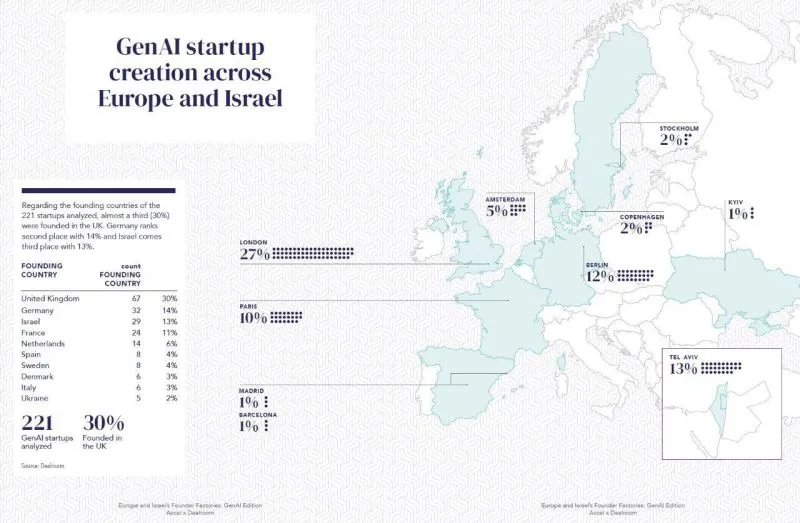
🚀 Recent data on the distribution of Generative AI (GenAI) startups across Europe and Israel highlights significant regional imbalances. Of the 221 startups analyzed, nearly 30% are based in the UK, followed by Germany (14%) and Israel (13%). London (27%) and Berlin (12%) stand out as key innovation hubs, attracting talent and investment.
🐢 In stark contrast, Central and Eastern European (CEE) countries, including Poland, show limited representation in this landscape. Ukraine, despite ongoing war challenges, has 1% of the startups, demonstrating resilience and potential. Yet, Poland, a CEE leader, remains underrepresented, raising questions about its readiness for the AI-driven economy.
A sobering indicator is the number of global-scale companies per 5 million inhabitants: Poland has just one, compared to Belgium’s 30. This disparity underlines the urgent need for strategic action to elevate CEE’s innovation capacity.
🧐 Bridging the Gap: What Can Be Done?
Invest in Education and R&D: A focus on advanced AI education and increased research funding is critical. Governments and universities must collaborate to build pipelines for AI talent.
Foster Startup Ecosystems: Stable regulations, venture capital networks, and startup-friendly policies—like those in the UK—must be developed in the CEE region to stimulate growth.
👉 Leverage Public-Private Partnerships (PPPs): Organizations such as United Heritage can play a pivotal role in bridging the gap. Their expertise in project management and infrastructure development is essential to nurturing innovation ecosystems.
👉 Capitalize on Regional Strengths: Ukraine’s IT sector and Poland’s logistics infrastructure are valuable assets. Cross-border cooperation can drive innovation and economic progress.
👇 Key Questions to Explore
❔ What specific barriers are hindering AI startup development in Poland and the broader CEE region?
❔ How can young talent in these countries be better supported?
❔ What strategies should private companies and investors adopt to close the innovation gap?
💥 A Call to Action
The global economy is shifting from traditional industries to digital and AI-driven models. For CEE countries, failure to act risks further marginalization in the tech race. Governments, businesses, and organizations must collaborate to create an ecosystem that nurtures startups and attracts investment. 🌱
🗯️ Private companies like United Heritage are vital to this transformation. By facilitating partnerships and innovation, they can help CEE countries emerge as key players in the AI-driven future.
Sources: Data from Accel & Dealroom, Business Insider, and Gov.pl.